Tire repair in Herzliya: how to tell whether a puncture can be fixed and what to check before replacement
A nail does not always mean a new tire, but a small hole does not guarantee a safe repair. Here is what to ask about inspection, the right Herzliya branch and the work you are approving.
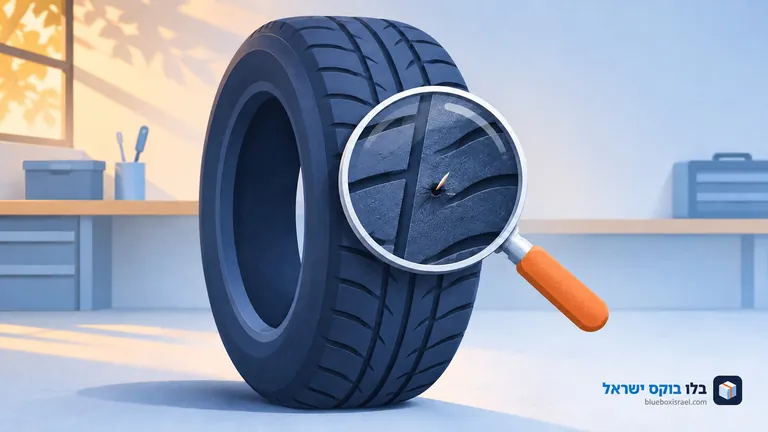
The tire-pressure warning comes on during the commute, or a wheel looks low when you return to a parking space in Herzliya. Before looking for an open tire shop, separate two decisions: whether the car can be moved safely, and whether the tire can be repaired. A small puncture in the repairable tread area may qualify for professional repair. Sidewall or internal damage may mean replacement. Inspection determines the answer, not the size of the nail visible from outside.
That distinction helps drivers who need to get on with their day. It makes it easier to explain the problem over the phone, understand a quote and ask for the reason behind a replacement recommendation. This is general information; the tire technician's inspection and the vehicle and tire manufacturers' instructions remain essential.
Decide how to reach the tire shop before choosing one
If the car is already parked with a flat tire, arrange assistance. Michelin warns that driving on it can cause hidden damage. A nearby workshop does not make that journey safe.
If the problem develops while driving, work toward a safe stop according to road conditions. Israel's National Road Safety Authority, known as Ralbad, warns that the road shoulder is a dangerous place to stop or deal with a puncture. If stopping there is unavoidable, use hazard lights, put on a reflective vest and move away from traffic, behind a barrier where safe. Arrange assistance rather than starting a wheel change beside passing vehicles.
Tell the assistance provider exactly where the car is, whether it is inside a parking garage and whether access is restricted. Mention any spare wheel or repair kit and consult the vehicle's instructions. Neither a kit nor a special tire type gives every vehicle the same permission to continue driving.
What makes a puncture a candidate for repair
The U.S. Tire Manufacturers Association, USTMA, sets out conditions for considering repair: the injury must be within the repairable tread area and no more than 6 mm across. Damage extending into the shoulder, where the tread approaches the sidewall, falls outside those conditions. These are professional guidelines, not automatic approval to repair any hole below that size.
Michelin requires removal from the rim for inspection and a combined internal patch and puncture-channel fill. An external plug alone is not a proper permanent repair. Ask what was found and how it will be repaired, particularly if it has been repaired before.
If replacement is recommended, ask to see the affected area and hear the reason: the injury's location, the tire's condition or damage revealed during removal. You do not need to perform the work yourself to understand that decision. An explanation connecting the finding to the proposed work lets you approve it with a clearer understanding, even when you are already at the workshop and pressed for time.
In Herzliya, confirm the branch as well as the business
Before selecting a workshop, check whether its address is in central Herzliya or the Herzliya Pituah industrial area. Ask for the full address and confirm when the branch can receive the car. Enter the agreed branch into navigation. If the vehicle needs recovery, give the assistance provider that same destination.
For example, Merkaz HaTzamig S.Y.'s Hebrew website for תיקון צמיגים הרצליה (tire repair in Herzliya) lists two branches: 5 HaSadnaot Street in Herzliya Pituah and 27 Hess Street in central Herzliya. Published hours are Sunday to Thursday, 07:00-17:00, and Friday, 07:00-14:00; Saturday is closed. The site lists wheel alignment at HaSadnaot. These details were checked on November 11, 2026; confirm availability before traveling.
Once you have chosen an address, ask whether the branch can accept the car now and what happens if inspection shows that a replacement tire is needed. Provide the vehicle model and the tire markings if they can be read or photographed safely while parked. Ask the technician to check suitability for the vehicle: a photograph is supporting information, not an automatic order for the same product.
Whether you are coming from work, home or outside the city, this preparation can help avoid an unnecessary journey. If you need to leave the car, ask when inspection is expected, how the findings will be communicated and who authorizes additional work. Do not assume the advertised closing time is also the latest arrival time for every service.
A tire-repair quote should describe the work
The homepage checked for this article did not display a fixed puncture-repair price. Ask for a quote that explains what is included: inspection, removal and refitting, the repair itself and balancing if required. Clarify what you would pay if the tire cannot be repaired, and whether the quoted total includes VAT.
For a proposed replacement, request the manufacturer and model, size, load and speed ratings, and warranty terms. A description such as "a good tire" or "something in the same size" does not tell you exactly what you are buying. Ask the technician to explain compatibility with the car's other tires and the manufacturer's requirements too.
Before approving the work, make a short note on your phone: what will be repaired, what will be replaced and the total price. Compare quotes for the same work and product. If diagnosis is still pending, ask for a conditional range and an explanation of when a final decision will be possible. Any change to the proposal should then have a clear basis: a new finding, different work and a price you have approved.
Puncture repair, balancing and alignment address different issues
Ask why an additional service is being proposed before deciding whether to approve it. NHTSA, the U.S. road-safety agency, distinguishes balancing a wheel for smooth rotation from adjusting wheel alignment. It recommends professional attention when tires produce noise or vibration, or fail to maintain proper pressure.
Describe symptoms that existed before the puncture as well: when a vibration started, the circumstances in which you noticed it and whether it has already been checked. That account is more useful than requesting a treatment you have heard about. If further work is suggested, ask which finding supports it and whether it is included in the agreed quote.
A common mistake is approving several services without understanding which one addresses the reason for the visit. Ask for the repair and any other maintenance to be explained and itemized separately. This keeps the decision manageable even when the visit began with an unexpected disruption.
What to clarify before leaving the workshop
Before collecting the car, take a moment for a few questions:
- What did the inspection find, and what work was performed?
- Was inflation pressure checked against the vehicle's instructions and relevant load?
- Does the tire-pressure monitoring system need any action specified in the owner's manual?
- If a tire was replaced, are its model and size recorded on the invoice?
- Who should you contact if the problem returns, and what does the stated warranty cover?
Ralbad recommends checking pressure every two weeks, using the vehicle's manual or placard and taking a cold-tire reading. Ask which pressure applies to your car after the work. Do not copy a setting from another vehicle because it looks similar.
For seasonal maintenance, see the site's article on preparing a car for Israel's first winter rain. Leave this visit with a more specific answer than "the wheel was sorted": what the damage was, how it was addressed and what needs checking afterward. If pressure falls again, return for investigation instead of allowing repeated inflation to become a substitute for resolving the problem.