How to Check a Used Car in Israel Before Paying: From the Paperwork to the Garage Inspection
A registration number is a good start, but it does not tell the whole story. Here is how to combine Ministry of Transport data, the seller's documents and a professional inspection before deciding to buy.
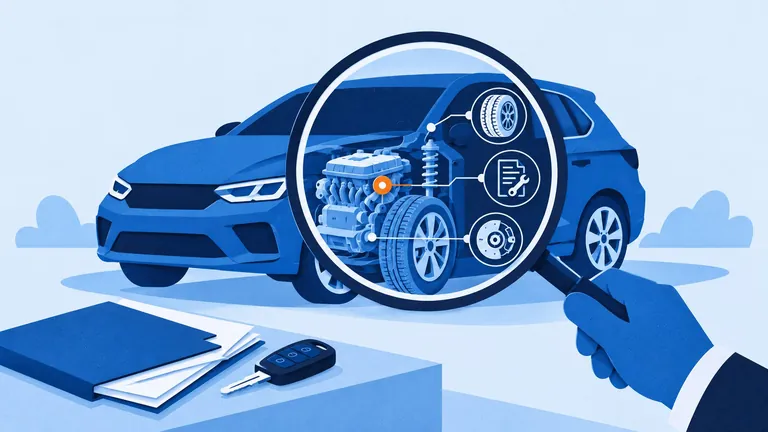
The seller says the car has been well looked after, the photographs look excellent and the price is right. Before arranging a test drive, ask for the registration number and basic documents. A few early checks can reveal whether the advertisement matches the car at all, saving you a journey, an inspection fee and an uncomfortable conversation after you have already decided you want it.
Work through the checks in stages: identify the car and its seller, compare official data with the documents, check its mechanical condition and only then agree on a deal. No single database certifies that a particular car is roadworthy, has never been in an accident and is free of other parties' rights. Each check answers a different question. This is general information for checking a potential purchase, not legal advice or a valuation of a particular vehicle.
Start with the registration number and the seller's identity
Ask for a legible copy of the vehicle license showing the details needed to identify it, and establish who the registered owner is and who will be a party to the sale. Personal information can be kept to a minimum at the initial stage, but before signing and paying, you need to verify the seller's identity and connection to the car. Saying "it is my brother's car" is not a document explaining who is authorized to sell it.
Compare the registration number in the advertisement, on the license and on the car itself. At the viewing, ask the professional inspector to check that the chassis number also matches the documents. Do not rely on the color and model name: the same model family can include different engines, trim levels and systems. If the details do not match, establish why before booking further services.
Ask on the phone how long the seller has had the car, where it was serviced and what they know about accident repairs, an engine replacement or other changes. Save the advertisement and the important answers in writing. The aim is not to judge whether the seller sounds convincing, but to prepare points to compare with the documents you will see later.
If the seller is a dealer, make sure you understand which business is selling to you and who appears in the transaction documents. Ask for the relevant disclosure and contract documents before paying. Do not transfer a deposit simply to "hold the car" without understanding in writing when it will be refunded and what will happen if the inspection finds a problem.
What Ministry of Transport databases reveal
The Ministry of Transport's private vehicle history database provides historical data for the vehicles it covers. Its description says it covers active private vehicles from 2017 onward. One file includes mileage recorded at the latest vehicle licensing test and indications of certain structural changes; another covers ownership dates and types.
That coverage matters: finding no result does not establish that the car has a problem, nor does it establish a clean history. The vehicle may not be included in that particular database. Read the data description, check that you entered the details correctly and look for an official database appropriate to the vehicle type, such as a personally imported car.
When comparing mileage, record a date beside each figure. A reading from an earlier licensing test does not necessarily have to match today's odometer. However, an odometer showing less than a previously recorded figure requires an explanation supported by documents. Do not decide for yourself that fraud occurred: a recording error or replacement component is possible, and these require professional investigation.
Ownership dates are not always precise to the day and month, either. The government database description notes that some information is presented by quarter. Do not construct a story about an unusually quick sale from data that does not offer that precision. Use it to ask focused questions, rather than fill gaps with your imagination.
The sequence of checks, from home to a purchase decision
- Collect the advertisement, registration number, model details and the seller's answers. Make a short list of what matters to you, such as an automatic transmission, space for a child safety seat or convenient parking access.
- Check the relevant official databases and compare them with the documents. Flag any discrepancy in ownership, mileage or specifications, and request clarification before the meeting.
- Ask for service records and invoices. Review the sequence of dates and mileage, looking for undocumented periods and repairs that need explaining.
- View the car in daylight and check whether it suits your needs. Try the seats, load your usual equipment and operate the systems, without dismantling parts or carrying out dangerous checks.
- Arrange an independent professional inspection at a place you choose. Tell the inspector beforehand about discrepancies you found, and ask whether additional checks are needed for the engine, transmission or traction battery.
- Ask for an explanation of the report and a written estimate for major repairs. Only then compare the total cost of the deal with alternatives you would actually consider buying.
- Before paying and transferring ownership, finish checking relevant rights and restrictions, arrange the paperwork and insurance, and document the agreed terms. If an important question remains unanswered, stop until you have an answer.
You can collect everything in one folder and include a date in each document's filename. That way, one car's report will not become mixed up with another's, and at the meeting you will not have to remember which seller promised to replace the tires and which claimed the major service had already been done.
Service history and mechanical inspection complement each other
A good service invoice shows what was actually done: the date, vehicle identification, mileage, and details of the work and parts. A stamp alone or a general statement that the car is "serviced on time" provides less information. Ask about items you do not understand, especially repeated repairs to the same system.
A complete set of documents still does not predict breakdowns. It helps the inspector decide where to focus. A missing invoice does not prove neglect, either, but if there is no record of a service the seller presents as a major advantage, there is no reason to treat it as established. You can ask the seller to obtain the documentation from the garage that serviced the car.
Before the professional inspection, agree on what the service includes and excludes. For a hybrid or electric car, ask explicitly whether the traction battery's condition is checked and by what method. For a modified vehicle, ask the inspector to identify the changes and their implications for maintenance, licensing and insurance. Do not assume a general report automatically covers specialized systems.
If you take a test drive, first confirm permission to drive and insurance cover appropriate to the driver and use. Choose a legal, safe route; hard acceleration is unnecessary to prove the car works. Noise, pulling through the steering wheel, vibration or a warning light are information for the inspector. They are not a basis for diagnosing the car yourself from a short video or guessing a repair price.
Ask the inspector to distinguish findings from matters still requiring investigation. General wording in a report does not always mean an immediate repair is necessary, but it is not a reason to ignore the system, either. If another check is recommended, establish who performs it and what it can determine. Until you have an answer, leave that item unresolved in your calculations. A price reduction for a fault that has not yet been defined does not necessarily compensate for the expense that may emerge after purchase. You can ask for a short delay in deciding so you can complete the checks.
The real price includes what happens after handover
A cheaper car may soon need spending on servicing, tires or an identified repair. Ask for quotes specific to the car and the finding, rather than a rough guess. Distinguish a safety defect requiring attention from expected wear and an upgrade you would choose to make. Each carries different weight in the decision.
Check insurance costs before closing the deal, too. Do not treat a quote the seller received as valid for you. The drivers, use and policy terms must fit your circumstances. Add fees and transaction costs at the price shown by the relevant service when you use it, without assuming an amount in an old post still applies.
Checking rights over the car is separate from the mechanical inspection. The Ministry of Transport operates a service for registering and removing liens, and the Corporations Authority provides services for searching security interests. The appropriate check also depends on the owner's identity. If the car is connected to financing or a company, seek professional help if you do not know which records to check.
Do not substitute a generic document sent by the seller without context for an actual inquiry. Make sure the document is current, refers to the correct car and answers the question you requested it for. A promise that "we will remove everything after payment" calls for stopping and resolving the issue, not rushing before the bank closes.
Common mistakes to spot before signing
A government report showing no irregularities is neither a certificate of mechanical condition nor a complete accident report. An inspection center's check, in turn, does not by itself verify all rights over the vehicle. Do not expect a document to answer questions outside its scope.
Another mistake is continuing merely because you have already spent time and money on checks. Those expenses have already been incurred; they do not turn an unsuitable deal into a good one. If a significant discrepancy emerges and the seller cannot explain it, you can walk away even at a late stage.
Finally, do not leave important promises as spoken conversations. Repairs before handover, equipment included in the price and payment terms must be clear and documented. When you collect the key, check that the car, the documents and the written agreement actually match.