Getting your car ready for Israel’s first winter rain: tires, visibility and the decisions that keep a journey safe
The first rain can reduce grip before puddles appear. Here is what to check on the car, how to adjust your driving and when to choose another route.
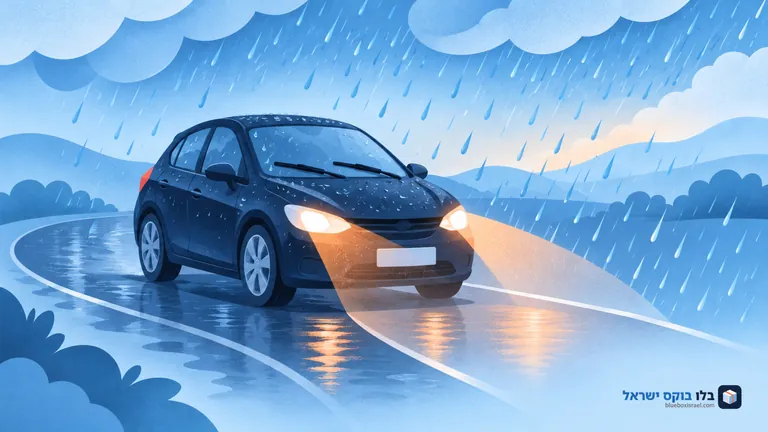
The wipers start moving, but the important change has already happened beneath the wheels. Rain after a dry spell mixes with dust and traces of oil on the road, potentially reducing grip before large puddles form. Preparing for winter in Israel therefore starts with two things: a roadworthy car and driving that leaves more time to react.
Before your next wet November journey, check the tires, wipers, lights and starter battery, then review the forecast and road closure notices. Once moving, reduce speed, increase your following distance and use smooth controls. If the road is flooded, take another route or postpone the trip. This is general safety information, not a substitute for a professional inspection, the vehicle’s manual or instructions from emergency personnel at the scene.
The first rain calls for a slower pace, even in midwinter
Israel’s National Road Safety Authority, commonly known by its Hebrew acronym Ralbad, explains that rain after dry weather mixes with accumulated road contamination to create a slippery surface. “First” is the potentially misleading word here. Rain following a break during the season can encounter another buildup of dust and oil. A storm last month does not make summer driving habits suitable today.
Reduced tire grip can lengthen braking distance. Poor visibility can also delay the moment you notice a hazard. Slow down before a bend, pedestrian crossing or accumulation of water, rather than waiting until hard braking becomes necessary. There is no single stopping distance in meters that applies to every car on every wet road.
Ralbad gives a baseline following interval of at least two seconds and recommends allowing more in winter. Choose a fixed roadside object and count from the moment the vehicle ahead passes it. In rain, increase that interval to suit visibility and grip; two seconds is not an adequate target for every situation. If another vehicle fills the gap, rebuild it gradually. Give pedestrians and traffic emerging from side streets extra attention.
Check tire depth, damage and pressure together
Regulation 322(c) of Israel’s Traffic Regulations requires at least 2 mm of tread profile or groove depth on the road-contacting surface of a pneumatic tire. The requirement includes the spare tire. Ralbad’s guidance repeats this minimum. It is a legal threshold, not confirmation that any tire above it will perform adequately in all wet conditions.
Tread grooves help move water away from the contact area. Do not judge the whole tire by its most visible section: ask for measurements at several points and a check for uneven wear. Look for cracks, cuts, bulges or swelling in the sidewall as well. Damage can make replacement necessary even when substantial tread remains. A qualified tire specialist should assess defects and replacement needs, while uneven wear also warrants investigation of its cause.
Falling temperatures can reduce inflation pressure. Measure it when the tires are cold, using the vehicle manufacturer’s placard or manual for the correct pressure at each wheel position and load. The maximum pressure printed on a tire’s sidewall is not the recommended setting for your car. Do not invent a separate “winter pressure” or let air out in an attempt to gain traction.
Ralbad recommends checking pressure every two weeks. Include the spare, if fitted, and investigate pressure that repeatedly drops in the same tire. Adding air does not repair a leak. Recent buyers can also use the site’s checks before paying for a used car in Israel, but preparing for rain matters just as much for a vehicle you have owned for years.
What summer leaves behind in wipers and batteries
Test the wipers while parked, with the glass wet. Deal with streaks, uncleared areas or damaged rubber before setting out. Fill the reservoir with washer fluid suitable for the vehicle and check that the jets work. Test the rear wiper, where fitted, and the demisting system too. The first fogged windshield is a poor moment to start looking for the right control.
Check headlights, rear lights, brake lights and indicators, and clean dirt from windows and lamp lenses. In Israel, from November 1 through March 31, private cars must use the required lighting on non-urban roads during daylight as well. Ralbad stresses that rear lights must be on. Make sure the lighting setting you select actually activates them; the presence of daytime running lights at the front is not enough to establish that. Use dipped headlights in rain and reduced visibility as conditions require.
The starter battery deserves attention after summer. Battery manufacturer VARTA explains that heat accelerates battery aging, with accumulated weakness sometimes becoming apparent when temperatures fall. If starting has become sluggish or the battery has already struggled, ask for a battery and charging-system check. Any replacement should suit the car and its electrical systems; the arrival of November alone is not a diagnosis.
Alongside the owner’s manual, car news and reviews in Hebrew can provide context about models and their systems. For an inflation setting, a suitable fluid or a fault that needs attention, return to the manufacturer’s instructions and a professional inspection.
A flooded road is a reason to change routes
Water covering a road prevents a reliable assessment of its depth or the condition of the surface beneath it. Another vehicle getting through is not a measurement, and greater ground clearance does not guarantee safe passage. Do not enter a flooded road, a low crossing where water is collecting, or flowing water across the route. Avoid descending into an underground car park that is beginning to flood, even to retrieve your vehicle.
Before leaving, check two kinds of information. The Israel Meteorological Service publishes forecasts and warnings, including flood and flash-flood warnings. Israel Police publishes road closure and traffic disruption notices. Match a warning’s geographical area and validity period to your planned route, rather than checking only the weather outside your home.
For police traffic information, call 110; for a police emergency, call 100. The two numbers serve different purposes. A navigation app can help plan an alternative, but it does not override a barrier or an officer’s instructions. Check updates before driving, and during the journey only through a passenger or after stopping safely.
If rain becomes so heavy that visibility no longer permits safe progress, Ralbad advises reaching a safe place away from the road and waiting. The road shoulder is not an appropriate place for a planned stop to wait out a downpour. Think ahead about where a safe stop is possible instead of starting that search only when visibility disappears.
Hydroplaning: avoid a sudden reaction
Hydroplaning, also called aquaplaning, occurs when a layer of water separates a tire from the road, reducing contact and control. Speed, the amount of water and tire condition affect the risk. That is a reason to slow before standing water and maintain the tires even when the car has driver assistance systems.
Guidance from tire manufacturers Michelin and Continental advises easing off the accelerator, holding the wheel and maintaining a steady direction if grip is lost while crossing water. Avoid sharp steering and sudden panic braking, allowing speed to fall until traction returns. An imminent collision still requires an emergency response appropriate to the situation; advice against abrupt reactions is not an instruction to withhold emergency braking.
Michelin also recommends switching off cruise control in rainy conditions where hydroplaning is a concern. Once grip returns, continue more slowly and reassess whether it is safe to proceed. Do not make a sharp corrective movement to compensate for the path the car has already taken.
Electric and hybrid cars need energy planning, and must avoid floods
Cold can affect electric driving range, while heating the cabin and battery consumes energy. Tesla explains that preconditioning while plugged in can draw power from the connection instead of the driving battery. If your model provides that feature, use it according to its instructions. There is no fixed percentage loss of range that applies to every car or every winter day in Israel.
In a hybrid, the gasoline engine may run for longer to provide heat. Toyota’s guidance notes that warming the engine and cabin can increase fuel consumption. Plan charging or refueling around the actual journey and conditions, leaving a reserve for delays or a detour. Conserving energy is not a reason to sacrifice effective demisting or a clear view.
When it comes to water, the type of powertrain does not authorize a flood crossing. Toyota warns against driving on flooded roads in a hybrid vehicle manual too. Tesla instructs owners not to attempt to operate a submerged vehicle before an authorized inspection. If the car has been flooded, get professional assistance and follow the manufacturer’s recovery and inspection instructions, even after the water has receded and there is no obvious external damage.
A short checklist before your next wet journey
- Check tread depth, tire damage and cold inflation pressure against the manufacturer’s instructions.
- Test wipers and washer jets while parked, top up suitable fluid and check demisting.
- Confirm that front and rear lights, brake lights and indicators work.
- Address starting problems and warning lights, and include brakes and steering in the vehicle inspection.
- Check weather warnings and road closures, with an alternative route and a fuel or charge reserve.
- Drive more slowly, leave a larger gap and stay out of water covering the road.
A check in the parking space can reveal a worn blade or low tire pressure; a professional inspection can find a fault that is not visible from outside. Whether to continue still depends on what is happening ahead. Even a car properly prepared for winter sometimes needs to wait until the route is safe.