How to plan a family trip to an Israeli nature reserve without getting stuck at the gate or on the wrong trail
A short trail is not necessarily easy, and closing time is not always the last admission time. Good family planning starts with your group and the chosen site's official information.
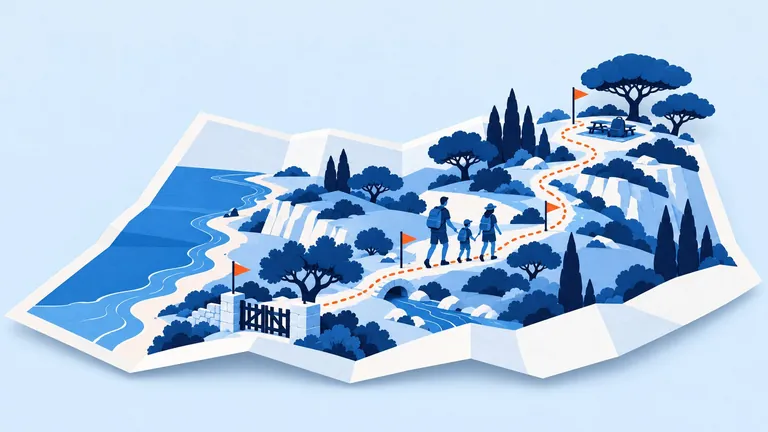
You have loaded the car, left early and reached the nature reserve. Only at the gate do you discover that your chosen trail is closed, your dog cannot enter or the last admission time has passed. Most of these checks can be made before setting out, but you need to check the specific site and trail, rather than rely on an attractive photograph and a general recommendation.
To plan a day that suits your family, start with participants' abilities and needs. Then check the trail, entry requirements, cost and directions, and prepare a shorter alternative. At Israel Nature and Parks Authority sites, official site information and visitor alerts matter more than an old trip description. A booking confirmation, if you have one, does not override a closure or a new safety instruction.
Choose a trail for the people coming, not the photograph
Before searching, decide what you want from the day: walking, a picnic, a viewpoint or a heritage-site visit. Choose one main attraction and keep another activity optional. That way, you will not have to rush along a trail to reach a distant attraction already booked for a fixed time.
List your group's actual limitations. Is there a stroller, difficulty with steps, a need for nearby toilets or a child who has not tried a long walk? A short distance on a map does not reveal climbs, rocks, ladders or exposed sections in the sun. Look in the official description for the terrain, walking time and suitability for visitors.
Distinguish between a circular trail and one that ends somewhere else. A non-circular trail requires a real return plan, not the hope of finding a taxi or a lift. Also check the distance between parking and the start of the walk. Sometimes a significant part of the effort comes before the point shown in the shortened trail description.
Choose according to the participant who needs the slowest pace, and allow time for breaks. The Israel Nature and Parks Authority recommends matching trips to participants' ages and abilities and finishing walks in daylight. Read the authority's safe hiking guidelines before choosing a trail, and contact its information line at 3639* if an essential detail is missing.
Check admission, hours and accessibility for the specific site
On the site's official page, look for opening hours, last admission and restrictions on your chosen trail. Do not assume the gate stays open until the latest time you may start every route. If trails, facilities or seasons have different hours, use the instructions that apply to your date.
The Israel Nature and Parks Authority has a visitor-booking system. According to its published information, advance registration reserves a place for the chosen time, while entry without registration depends on availability and site instructions. Check your destination's current conditions and keep the confirmation easy to find on your phone. Make sure it covers the right area, number of participants and requested date and time.
Booking a visit and paying are not necessarily the same step. Read what the confirmation includes and what remains to be arranged. If using a membership or discount entitlement, check which documents are required and whether the benefit applies to everyone. Do not assume a photograph of another family member's card will replace identification or a personal membership.
Accessibility has several components: parking, the route from the parking area, toilets and the trail itself. The Israel Nature and Parks Authority publishes accessibility information and a map, but a general accessibility label does not guarantee that every path suits a wheelchair or stroller. Ask specifically about the section you intend to visit. If bringing a dog, check the particular site's admission policy and restrictions separately.
Practical planning from choosing a destination to setting out
- Identify the participants and the kind of day you want. List needs such as a route without steps, a limited walking distance, nearby toilets or a picnic area, and choose a destination that meets them.
- Read the site page and official trail description. Check length, difficulty, path type, last admission and how to reach the start from the parking area.
- Check availability and book if necessary. Confirm visitor numbers, payment terms, discounts and required documents, and keep the booking confirmation.
- Plan the entire day: travel, parking, admission, food and the return time. Allow room for breaks and changes without cutting corners on safety.
- Prepare equipment suited to the trail and forecast, and choose a short, accessible alternative that is not exposed to the same risk that might cancel your original plan.
- Shortly before departure, recheck alerts, weather and security instructions. Tell someone who is not traveling with you the route and planned return time.
- On arrival, read the signs and listen to staff instructions. Adapt the day to actual conditions, and cancel any unsuitable part even if it was the original reason for the journey.
If more than one family is coming, send everyone a single summary: meeting point, route, personal equipment, required confirmation and departure time. Distinguish between what each family brings for itself and shared equipment. That prevents discovering at the gate that everyone assumed someone else had brought the water or saved the booking.
Budget for the whole day
Admission is only part of the expense. Add travel, parking where required, food, additional activities and any other known costs. Use the price list on the official website when planning, according to participants' ages and relevant eligibility. Do not copy a price from an old article and build the budget around it.
When comparing two destinations, compare the same experience. A distant free site requiring a long drive and a meal on the way may cost more than a nearby paid site. This is not a claim about a particular place, but a way of calculating: write down the expected expenses for each option and decide what matters to your family.
Assess a membership against realistic use too. If considering a Matmon membership, the authority's visitor pass, read its current terms, membership composition, and included sites and services. Compare it with visits you actually plan, without counting trips you might take merely to justify buying it.
You can simplify the budget by planning around one main activity and bringing food from home, subject to site rules. If a cafe or restaurant matters to you, check hours and seating separately. Do not rely on a snack bar without confirming that it operates, and do not cut water or essential equipment to reduce spending. Money saved at the expense of suitable trip conditions is not a useful saving.
For public-transport users, checking the return journey is as important as checking the outward trip. Look for services on the correct date and day of the week, including weekend and holiday changes. Check the distance from the stop to the gate and whether it is safe to walk between them. A site's name on a timetable does not guarantee the bus stops at the correct entrance. Allow time to reach the return stop, and do not build your day around the last service without a verified alternative. If there is no suitable way back, choose another destination.
Prepare equipment and a genuinely usable alternative
The Israel Nature and Parks Authority stresses carrying an up-to-date map, water, suitable walking shoes and clothing, and staying on marked trails. Match your water supply to the trip's duration, region and conditions according to the trail guidelines. Do not rely on there being a stream or an open tap at your stopping point.
Keep a map available without assuming there will be reception everywhere, and make sure you have enough battery power. A map downloaded in advance helps with navigation, but cannot tell you about a closure imposed after downloading. Current signs and instructions on the ground still apply. If you lack information about the route or your ability to complete it, ask before starting.
A good alternative need not be another famous destination. It could be a short visit to another site that suits the conditions, or postponing the trip. If a weather warning or security instruction prompts the change, do not automatically choose a nearby trail in the same area. Check that the alternative is also permitted and appropriate.
Decide in advance on a point at which to reassess whether to continue. A tired child, delayed entry or changing conditions can justify shortening the day. Do not divert onto an unmarked path to "save time." You can skip a viewpoint and still have a successful day; it is harder to fix a plan you pursue only because you have already traveled a long way.
Common mistakes that make a simple trip complicated
"Family-friendly" is not a sufficient description. Look for details about the route itself and its suitability for your ages and needs. Photographs of strollers at the entrance do not prove they can be taken along the entire trail.
Do not rely on navigation to a stream or reserve's general name. Use the site's directions to identify the correct entrance and parking area. If the road is unsuitable for your vehicle, stop and check rather than continuing because an automated navigation instruction says so.
Finally, if you are not coming, cancel the booking according to the instructions you received and separately check payment cancellation terms if you have paid. Leave space in your car and bag for your rubbish, and keep your distance from wildlife without feeding it. The day ends when everyone returns with the equipment and rubbish they brought.